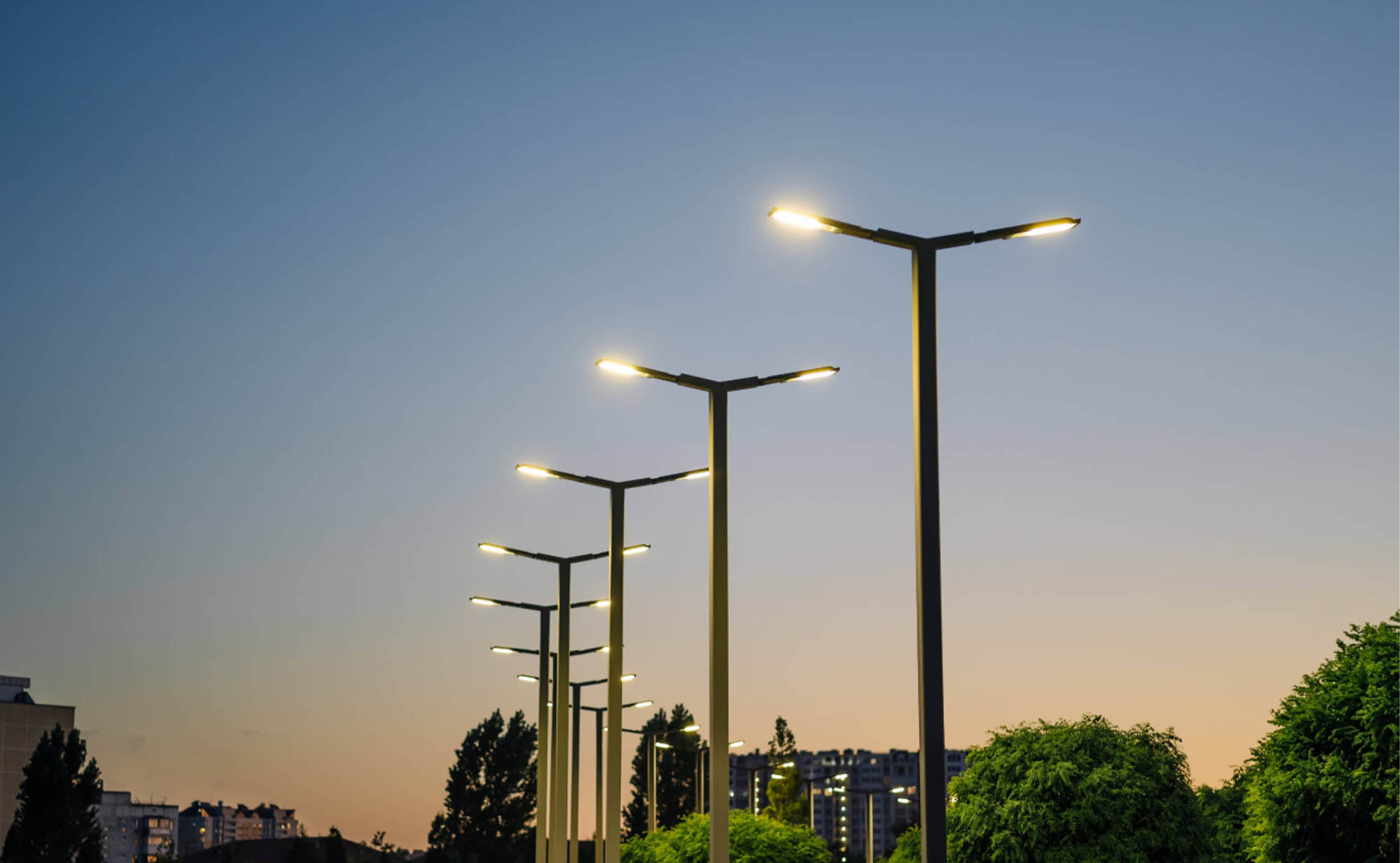
LED lighting for sports fields has become the most effective solution for addressing one of the main problems in sports facilities: dark areas and blind spots. These underlit areas not only affect the visual quality of the game but also have a direct impact on player safety and athletic performance.
Dark areas are sections of the playing field where the lighting level is significantly lower than the rest of the field. They are not always visible to the naked eye, but they become apparent when the ball seems to "disappear" in certain areas or when players have difficulty anticipating movements. Additionally, shadows may appear that distort the perception of depth and distance.
The origin of dark areas is usually related to several technical factors:
- Incorrect distribution of light fixtures, with poorly positioned light points
- Inadequate mast heights, which create long shadows
- Inefficient optics that scatter light instead of directing it to the field
- Outdated technologies, incapable of providing uniform lighting
- Absence of a prior lighting design, based only on power and not on uniformity
LED lighting for sports fields allows these problems to be corrected at their root, as it offers much more precise control of the light.
Uneven lighting forces players to constantly strain their eyes to adapt to sudden changes in light. This leads to eye fatigue, perceptual errors, and reduced reaction time.
Dark areas increase the risk of injury. When a player doesn't accurately perceive the position of teammates, opponents, or the ball, the likelihood of sudden movements, misjudged tackles, or falls increases.
En Solydi We specialize in LED lighting for sports facilities, starting from a professional lighting design adapted to each space and sport.
LED lighting for sports fields versus the traditional system

LED lighting for sports fields versus traditional systems
LED lighting for sports fields, compared to traditional systems, marks a turning point in how sports facilities are illuminated. For years, technologies such as halides Metallic or sodium vapor lamps have been the standard solution. However, their limited control and poor light uniformity make them one of the main causes of shadows and blind spots.
Traditional systems were designed in an era when the priority was simply "providing light," not optimizing it. These technologies have several clear limitations:
- Imprecise light distribution, with wide and poorly directed beams
- Over-lit areas and under-lit areas
- Difficulty adjusting the orientation of the projectors
- Light loss outside the field, which does not contribute to visibility
- Slow start-up and reduced light stability
As a result, even installations with high installed power suffer from uneven lighting, generating annoying shadows and blind spots that are difficult to correct.
Lack of uniformity: the big problem
Uniform lighting is one of the most critical factors in sports lighting. Traditional systems often offer uneven illumination, with significant contrasts between central areas and peripheral zones of the field.
This lack of uniformity forces players to constantly adapt to changes in lighting, affecting their perception of the game. In this context, LED lighting for sports fields represents a radical improvement.
Light control: LED versus older technology
One of the great advantages of LED lighting for sports fields is the precise control of the light beam. Unlike metal halide or sodium lamps, LEDs use specific optics that direct the light exactly where it is needed.
This allows the field to be illuminated evenly, reduces shadows caused by players and structures, and avoids unnecessary glare.
Traditional systems lack this precision, which greatly limits their ability to provide quality lighting.
Adjustment and adaptation to each field
Another key difference is adaptability. With traditional systems, any change in field layout or use requires complex modifications.
LED lighting for sports fields allows for much more flexible adjustment of optics, angles, and power, adapting to different sports disciplines and configurations.
Visual performance and sports experience
The LED lighting not only improves uniformity but also visual quality. It offers better color reproduction and a more natural perception of the surroundings, making it easier to track the ball and quick movements.
This is especially important in night sports or training in conditions of low natural visibility.
Consumption and efficiency as added value
Although the main focus is visibility, it cannot be ignored that LED lighting for sports fields also reduces energy consumption.
Lower consumption allows for the installation of more well-distributed light points without increasing costs, reinforcing uniformity without financial penalty.
LED lighting design for sports facilities

LED lighting for sports fields reaches its full potential when combined with a professional lighting design. One of the most common mistakes in outdoor sports facilities is thinking that simply replacing old floodlights with more powerful LEDs is enough.
Without proper preliminary study, even the best technology can generate dark areas, unwanted shadows, and uneven lighting.
Lighting design is the process of defining how, where, and with what intensity a sports field is illuminated. Before installing any LED lighting fixtures, it is essential to conduct a technical study that considers aspects such as: the dimensions of the field, the type of sport, the required lighting levels, and the environmental conditions.
In LED lighting for sports fields, this design is key to ensuring that the light reaches the entire playing surface evenly; without blind spots or excessive contrasts.
Lighting calculations: the basis of uniformity
Lighting calculations allow for the simulation of light behavior before actual installation. Specialized software is used to analyze illuminance levels, uniformity, and luminous flux distribution in each area of the field.
This step is essential for detecting potential shadows or poorly lit areas and correcting them during the design phase. In LED lighting for sports fields, lighting calculations prevent improvisation and ensure the system meets standards.
Correct distribution of projectors (H4)
It's not just the number of projectors that matters, but how they are distributed. Poor distribution can concentrate too much light in some areas while leaving others insufficiently illuminated.
A well-planned LED lighting design for sports fields defines the exact location of each projector to achieve balanced coverage; avoiding unnecessary overlaps or areas without adequate lighting.
Installation orientation and angle
Proper orientation of LED projectors is another crucial factor. An incorrectly adjusted angle can cause long shadows, glare, or light loss outside the field of view.
Thanks to the precision of LEDs, each light fixture can be accurately positioned, directing the light onto the playing field and optimizing uniformity. This adjustability makes lighting design a fundamental tool for eliminating blind spots.
Adaptation to the type of sport
Each sport has specific lighting needs. A football pitch doesn't require the same lighting as a tennis court. Lighting design allows LED lighting for sports fields to be adapted to each use, guaranteeing adequate light levels and an optimal viewing experience.
LED lighting for sports fields and the placement of luminaires
LED lighting for sports fields only eliminates shadows and blind spots when the luminaires are correctly positioned. Even with high-quality LED floodlights, poor placement of light sources can create dark areas, glare, or uneven illumination. Therefore, the location of the luminaires is one of the most critical aspects of lighting design in outdoor sports facilities.
The height of the masts: key to reducing shadows
The height of the flagpoles directly influences how light falls on the field. Flagpoles that are too low cast long, harsh shadows, especially when players are moving quickly or the ball is in the air.
In LED lighting for sports fields, a greater height allows the light to reach at a wider angle, reducing harsh shadows and improving uniformity.
Distance between light points
Another determining factor is the distance between the light sources. When the projectors are too far apart, areas of lower illuminance appear between them. Conversely, a well-balanced distribution allows the light beams to overlap in a controlled manner, eliminating blind spots.
LED lighting for sports fields benefits particularly from proper spacing.
Installation angle: precision versus improvisation
The installation angle is one of the most underestimated elements in sports lighting. A poorly aimed floodlight can waste a large portion of its light output or create glare that affects both players and spectators.
Thanks to the precision of the optics, LED lighting for sports fields allows you to direct light to the necessary areas of the playing field. Proper angle adjustment reduces shadows, improves visibility, and prevents light loss outside the field.
Coordination between height, distance and orientation
These three factors should not be analyzed in isolation. Their correct combination is what guarantees uniform lighting.
A professional LED lighting design for sports fields studies how these elements interact to achieve an optimal balance; adapted to the dimensions and characteristics of the field.
LED lighting for sports fields and light uniformity
LED lighting for sports fields and its uniformity are among the most crucial factors in eliminating shadows and blind spots. It's a common mistake to think that poor lighting can be solved simply by increasing the wattage. However, in sports lighting, more watts don't necessarily mean better visibility if the light isn't properly distributed.
Lighting uniformity refers to the regularity with which light is distributed across the entire playing surface. A field with good uniformity has similar levels of illumination throughout, avoiding harsh contrasts between brightly lit and darker areas.
In LED lighting for sports fields, uniformity is key so that players, referees and spectators perceive the playing field as a continuous space; without areas that hinder vision or alter the perception of the ball and movements.
Why “more power” is not the solution
Installing more powerful projectors can have the opposite effect to what is desired. Areas near the lights become over-illuminated, while other areas remain under-lit. This causes annoying glare, harsh and elongated shadows, eye strain, and a loss of spatial awareness.
LED lighting for sports fields demonstrates that the goal is not to concentrate light, but to distribute it evenly.
How LEDs improve uniformity
LED technology allows for precise control of the light beam, thanks to specific optics designed for sports lighting. These optics direct the light exactly where it is needed, preventing dispersion and loss.
Furthermore, LEDs allow for the installation of more light points with lower individual wattage, achieving uniform coverage without increasing energy consumption. This strategy is essential for improving uniformity without creating over-illuminated areas.
Relationship between uniformity and athletic performance
Uniform lighting allows players to better anticipate movements, judge distances more accurately, and react faster. In dynamic sports, the difference between uneven and uniform lighting can directly impact performance and safety.
LED lighting for sports fields ensures that visibility is constant at any point on the field, regardless of the position of the player or the ball.
Safety and visual comfort
The lack of uniformity forces the eye to constantly adapt to changes in light, which causes fatigue and increases the risk of errors. A well-designed LED system reduces these contrasts, improving visual comfort and decreasing the likelihood of accidents.
Adapting LED lighting for each type of sport

LED lighting for sports fields cannot be considered a generic solution suitable for any facility. One of the most common mistakes is designing a "standard" lighting system without taking into account the type of sport, the dynamics of the game, and the actual use of the field.
Each discipline has different visual needs and, if they are not adapted correctly, shadows, dark areas or glare may appear.
Not all sports are played at the same pace or from the same visual perspective. Some require a wide view of the field, others focus on a specific area, and still others incorporate constant vertical movement. LED lighting for sports fields allows for adaptation to these differences thanks to its precision and flexibility, provided the design takes into account the use of the space.
LED lighting for football fields
In sports like football and rugby, the playing field is large and the movements are fast and continuous. Here, the priority is high uniformity across the entire surface to avoid dark areas in peripheral zones.
LED lighting should be evenly distributed from multiple points, avoiding long shadows that hinder tracking of the ball and players. Proper orientation of the floodlights and appropriate mast height are essential to eliminate blind spots on this type of field.
LED lighting for tennis courts
In tennis, the visual demands are different. Ball tracking is fast and occurs both horizontally and vertically. Therefore, LED lighting for sports fields on tennis courts must minimize shadows and glare, especially when the player is looking upwards.
The key lies in well-distributed side lighting, with specific optics that prevent the light from directly impacting the players' field of vision.
LED lighting for padel courts
Padel combines fast-paced play with smaller spaces, often enclosed with glass walls. Here, glare control and uniformity are crucial to avoid reflections and shadows cast by the structures.
LED lighting for sports fields in padel courts must be integrated with the design of the venue; guaranteeing a homogeneous light that does not generate contrasts or dark areas in the corners.
LED lighting for athletic tracks
In athletics, perimeter visibility is key. Shadows in lanes or jumping areas can compromise safety. LED lighting must ensure uniform coverage on both straightaways and curves, avoiding differences in light between lanes.
Here, the precise distribution of the luminaires and the correct selection of optics play an essential role in maintaining constant lighting levels.
LED lighting for basketball courts
Outdoor basketball courts have very specific lighting requirements that must be addressed to avoid shadows and blind spots. Unlike other sports, basketball combines quick movements, constant changes of direction, and a very vertical style of play. Tracking the ball in the air is continuous.
In this context, LED lighting for sports fields applied to basketball courts must prioritize very high uniformity; both on the horizontal plane (court floor) and on the vertical plane, where much of the game takes place.
The importance of the actual use of the field
Many sports fields are multipurpose, used for different disciplines or training. LED lighting for sports fields allows the system to be adapted to these uses through regulation and control, preventing shadows when the field is used partially or with different configurations.